
Culture in Cloth

Connecting women through time, place, and craft in northeastern Madagascar

Betsimisaraka elders weave rare raffia cloth on a traditional floor loom (2026). (Rachel Kramer/CPALI)
Weaving Identity
The Betsimisaraka people of northeastern Madagascar, known as "the many inseparables," have long found strength in common identity. For generations, Betsimisaraka women have expressed their identity by weaving native raffia palm cloth. Tightly woven for impermeability in the rains that travel across the Indian Ocean and fall on forests, rice paddies, and villages of northeastern Madagascar, traditional raffia fabric was once a part of everyday life. Crafted on looms fashioned from banana trunk, native bamboo, and other local materials, the functional cloth conveyed belonging and embodied its weavers' strong connection to the natural world.

Woven raffia cloth in a contemporary pattern inspired by traditional Betsimisaraka warp stripe (2026). (Tanana Madagascar)
Preserving Tradition
Today, the tradition of weaving Betsimisaraka raffia cloth has all but disappeared.
Over time, with the arrival of imported materials through trade, raffia garments have become rare in northeastern Madagascar. As generations have passed, knowledge of how to construct and operate traditional floor looms, and how to create distinctive Betsimisaraka woven stripe patterns, is all but gone.
For CPALI, supporting local women to preserve cultural heritage through textiles has become inseparable from our mission to build a future in which people and nature thrive.
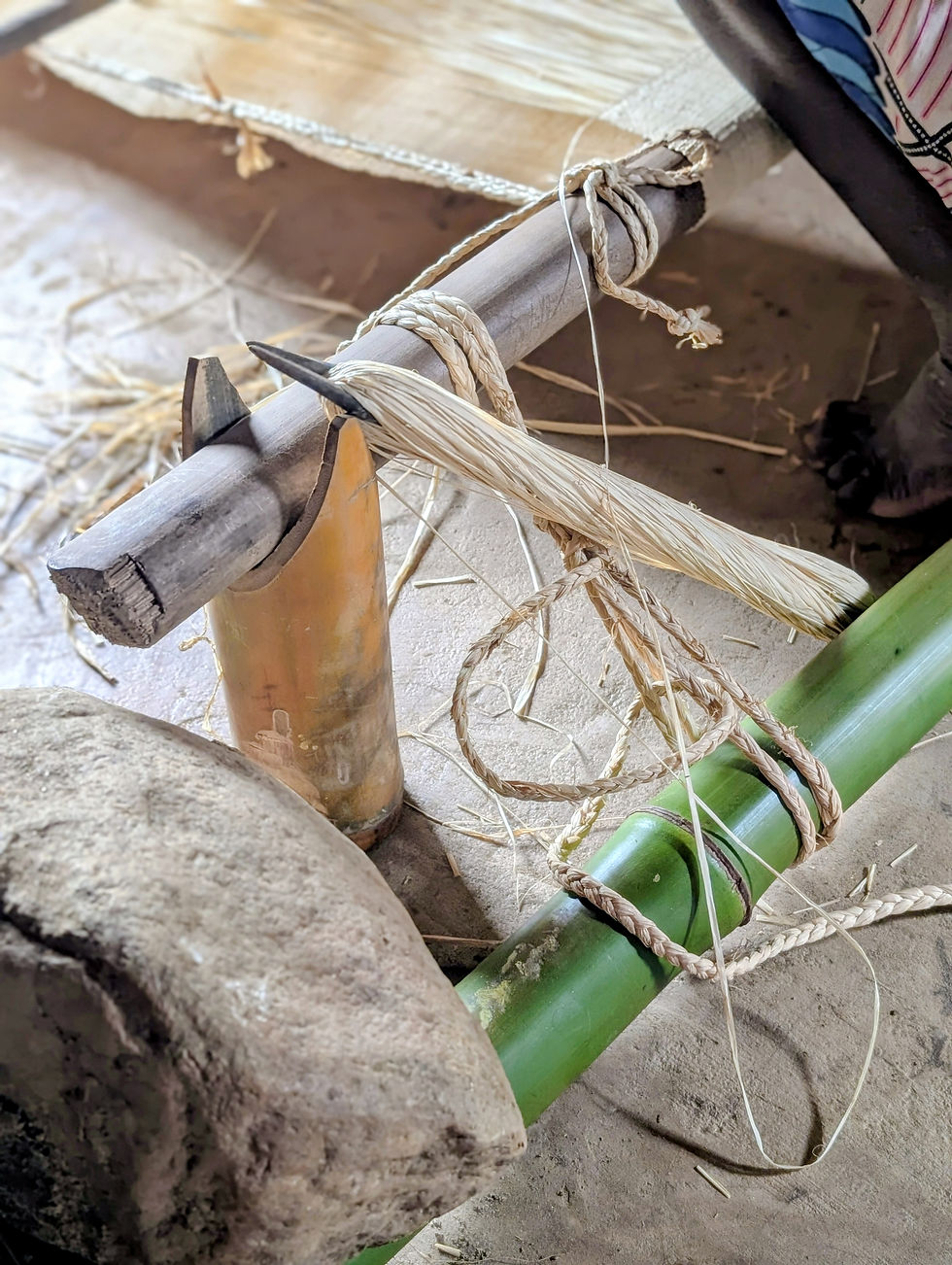
Braided raffia rope and river stones anchor a traditional Betsimisaraka loom built by elders (2026). (Rachel Kramer/CPALI)
Through shared social enterprise and village-based artisan skills development, the artisan team behind Tanana Madagascar textiles is working hand-in-hand with elders to sustain and evolve this remarkable craft. Journey with us in pictures to discover the story behind Tanana Madagascar's new Harungana woven raffia cloth collection for Selvedge Artisan Goods.
Honoring the Past
Like the chameleon, artisans keep one eye on the future, and one on the past. To practice contemporary raffia weaving in northeastern Madagascar, it's important to understand the heritage of the cloth.
Unlike the Kuba raffia textiles of Central Africa that are known for their intricate surface embellishments, Madagascar Betsimisaraka cloth is characterized by its fineness and simple patterning. The Berg Encyclopedia of World Dress and Fashion: Africa (2010) describes Betsimisaraka cloth's connection to place and its traditional functional value:
“Along the east coast, the area of the peoples known as the Betsimisaraka, the predominant fiber used in weaving (a female preoccupation, as in most of Madagascar) is raffia. This is produced in rectangular lengths usually with warp striping. Two garments are typically produced from these cloths. One is a wraparound tubular garment (sadiaka) that is worn by women around the waist or secured above the breasts. The other common type of raffia garment is a kind of smock for men tailored with openings for the arm and at the neck. This is known as an akanjobe (from akanjo, a shirt or blouse).”

'Femmes Betsimisarakas puisant de l'eau' (1890-1910). (Creative Commons)
Few examples of traditional akanjo woven raffia shirts have been preserved. But a handful of elders along northeastern Madagascar's Antainambalana River have tenderly kept pieces handcrafted long ago for loved ones. When asked, they showed them to the Tanana Madagascar artisan team.

A child's shirt, hand-crafted from tightly woven raffia cloth, kept by a village elder (2026). (Rachel Kramer/CPALI)
A few traditional sadiaka woven raffia wraps have been preserved by local grandmothers. Their tight weave and irregular knotted threads evoke another age when handcrafted cloth was proudly worn to convey heritage and skill.

Betsimisaraka elders on the Antainambalana River show their legacy of raffia cloth (2026). (Rachel Kramer/CPALI)
In place of sadiaka, many Betsimisarka women wear colorful lambahoany, today. Machine made from imported cotton, these reflect more modern Malagasy culture. Seeing a grandmother wear traditional raffia sadiaka cloth is exceedingly rare.

An elder displays her traditional raffia wrap skirt in northeastern Madagascar (2026). (Rachel Kramer/CPALI)
Connecting Women, Conveying Craft
To keep traditional weaving in practice, Tanana Madagascar is connecting contemporary Betsimisaraka weavings to fair markets. Over the last decade, the Tanana artisan team, led by Lalaina Raharindimby, has sought tutelage from local elders. Together, they have adapted traditional weaving for modern looms and designs. But the process behind Betsimisaraka raffia production remains traditional.
Pruning
Creating raffia cloth begins with carefully pruning young fronds of the mature palm. This activity is traditionally performed by men. To empower farmers to plant more palms in rainforest-bordering landscapes, Raphia farinifera has been incorporated as a focal species in the CPALI-SEPALI Madagascar Regenerative Agroforestry Initiative.

Raffia palms planted on the margin between rice paddies and agroforestry plots (2025). (Rachel Kramer/CPALI)
Stripping
To yield flexible fibers, the inner membrane of each frond leaflet is removed. Each strand is expertly stripped using a traditional rice-harvesting knife and dried in the sun.

Inner membranes are stripped from pruned raffia palm fronds for drying (2025). (Rachel Kramer/CPALI)
Cutting
Raffia fibers are cut by weavers to their desired length and width using traditional tools, including blacksmith-crafted metal combs and rice-harvesting blades. Both hands and feet are used in the process.

Cutting uniform thin raffia threads for loom weaving (2026). (Rachel Kramer/CPALI)
Loom building
A traditional Betsimisaraka floor loom is assembled in a complex process that takes three women one full day. When fully threaded, the raffia weaving process begins.

A traditional Betsimisaraka floor loom in an elder's home along the Antainambalana (2026). (Rachel Kramer/CPALI)
Teaching
No woman is born a weaver. Passing down knowledge from one generation to the next is integral to sustaining this textile art. Tanana Madagascar sources traditional raffia cloth directly from village elders, as well as weaving contemporary cloth at the workshop.

Elders in the village of Ambodivoangy mentor Lalaina Raharindimby (2026). (Rachel Kramer/CPALI)
Reviving Natural Dyes for Modern Cloth
Few examples of early Betsimisaraka raffia cloth are preserved in museum collections. Introduced dyes arrived in Madagascar long ago through trade routes, making it difficult to know what endemic plant colors would have been used in traditional raffia cloth a century ago.
Elders in villages along the Antainambalana River have introduced the Tanana Madagascar artisan team to leaves of the native Harungana 'dragon's blood' tree (Harungana madagascariensis). The leathery leaves color raffia strands shades of blue-grey to black, depending on how long the dye baths boil and colors are left to set.
Leaf collection
Harungana leaves are gathered by farmers from trees growing on their lands. To ensure sustainable supply and return this disappearing tree to degraded landscapes, Harungana is a focal species in the CPALI-SEPALI Madagascar Regenerative Agroforestry Initiative.

A farmer travels down the Antainambalana River with Harungana leaves and raffia fronds (2025). (Rachel Kramer/CPALI)
Dye baths
At the Tanana Madagascar artisans workshop, Harungana leaves are boiled in dye baths. Forest-saving energy bricks, made by local farmers using invasive water hyacinth, high energy-density seeds, and banana glue, are used in the process to limit the footprint of the textile production process.

Harungana leaves (center) are boiled in a dye bath to color silk and raffia black (2026). (Rachel Kramer/CPALI)
Weaving
Just four artisans at Tanana Madagascar have honed the skills to weave Betsimisaraka raffia cloth: Sabine, Sabrina, Sidonnie, and Beatrice. They weave patterns of their own design on locally-carpentered looms using natural and Harungana-dyed threads.

Sabine weaves a raffia runner in her signature chevron design (2026). (Rachel Kramer/CPALI)
The contemporary woven designs range from traditional Betsimisaraka stripe, to cross-hatch, to modern chevron and abstract patterns. The intensity of the black Harungana dye varies for each pattern.

Strands immersed for various times in Harungana leaf dye baths are woven into this textile. (2026). (Tanana Madagascar)
Weaving Change
Tanana Madagascar's Harungana-dyed woven raffia collection is more than a celebration of exceptional craft—it's a testament to what becomes possible when traditional knowledge, contemporary design, and purpose come together. Shared creativity across elders and a new generation of Betsimisaraka artisans is opening new pathways for people to honor their culture and protect the natural world.

About Tanana Madagascar
The shared social enterprise of the non-profits CPALI and SEPALI Madagascar, Tanana Madagascar supports biodiversity, women-powered enterprise, and local innovations that help restore landscapes and strengthen families.


