
Pause and reflect: Six months, six areas of impact

Updated: Sep 4
In northeastern Madagascar the future of conservation depends on families who live alongside nature seeing fair benefits from sustaining biodiversity. In the first half of 2026, CPALI and SEPALI Madagascar continued to work hand-in-hand to deliver an impact-driven social enterprise and to advance initiatives that strengthen economic lives, regenerate nature, and elevate innovative local ideas in one of the world's most precious biodiversity hotspots. At the mid-year point, join us in pausing and reflecting on how far we've come and where our journey will take us next.

SEPALI Madagascar Director Mamy Ratsimbazafy holds an endemic silk moth (Antherina suraka) in a new rearing habitat established in early 2026. The habitat will be an important space for educating a new generation of regenerative wild silk farmers in northeastern Madagascar. (Photo: Michael Listgarten)
"Every day our shared programs demonstrate what's possible when conservation, poverty alleviation, and artistic visions intersect. Local farmers and artisans are regenerating nature on their own terms—that's a powerful thing."
-Rachel Kramer, CPALI Executive Director

Above (left to right): CPALI Board Chair Petra Silton, SEPALI Madagascar Lead Artisan Lalaina Raharindimby, and CPALI Executive Director Rachel Kramer meet with CPALI's first farmer partner from two decades ago in his Makira Natural Park-bordering village. The community's current farmer leader, Donnis (far right), now spearheads regenerative agroforestry efforts. (Photo: Michael Listgarten)
Impact Area 1: Poverty Alleviation
We believe conservation succeeds when families have access to meaningful economic opportunities that work with nature. Through our shared programs, 1,032 handcrafted creations were connected to fair markets in the last six months. 100% of sales revenue was returned to locally run initiatives in Madagascar that delivered fair, full-time employment to 21 people and helped local farmers earn 315 school fees to invest in their children's futures.

Above: Tasio on the SEPALI Madagascar agroforestry team works with Makira Natural Park-bordering farmers to plant raffia palm seedlings on deforested lands. As the young palms mature, farmers prune their fronds and local artisans strip and dry the inner membranes. Selling sustainably harvested raffia threads at fair prices for use in handcrafted Tanana Madagascar products delivers an important source of local household income. (Photo: Rachel Kramer/CPALI)

Above: Local partners in a Makira Natural Park-bordering community collaborate with SEPALI Madagascar to plant endemic host trees for wild silk moths together with shade coffee, fruit trees, and other locally valued tree crops that deliver economic benefits on different time horizons. (Photo: Rachel Kramer/CPALI)

Above: Members of the SEPALI Madagascar full-time artisan team in the northeastern town of Maroantsetra crochet a new line of co-designed raffia handbags for the 2026 Tanana Madagascar-Ibu Atelier program partnership. (Photo: Rachel Kramer/CPALI)
Impact Area 2: Conservation - Shifting the Power Dynamic
Conservation solutions should begin with listening to local interests and investing in local ideas. In the past six months, 1,500 forest-saving energy bricks have been produced by forest-bordering farmers using invasive plants as an alternative to expensive, forest-depleting charcoal. Twenty forest-saving stoves have been constructed so far this year to pilot low-footprint household cooking using the invasive plant energy bricks.

Above: Energy bricks made from invasive water hyacinth, oil rich seeds, and banana glue are stored at the SEPALI Madagascar artisans workshop to power team designed stoves. Stationary stoves are used for wild silk and raffia textile dye baths. Portable stoves are being trialed for household cooking. (Photo: Rachel Kramer/CPALI)

Above: Locally built portable stoves that run on invasive plants are being piloted for home cooking use by volunteers this season. (Photo: Rachel Kramer/CPALI)
Impact Area 3: Nature-positive Innovation
Innovation doesn't always require new technology. Sometimes it begins by seeing nature differently. Over the past six months, SEPALI Madagascar full-time artisans have continued to work with 6 endemic wild Madagascar silks reared and collected by local farmers to craft Certified Wildlife Friendly and Fair Trade textiles that celebrate endemic species and regenerate biodiversity on the margins of critical protected areas. By developing new materials rooted in ecological stewardship, this local effort proves that conservation can inspire innovation—not exploitation.
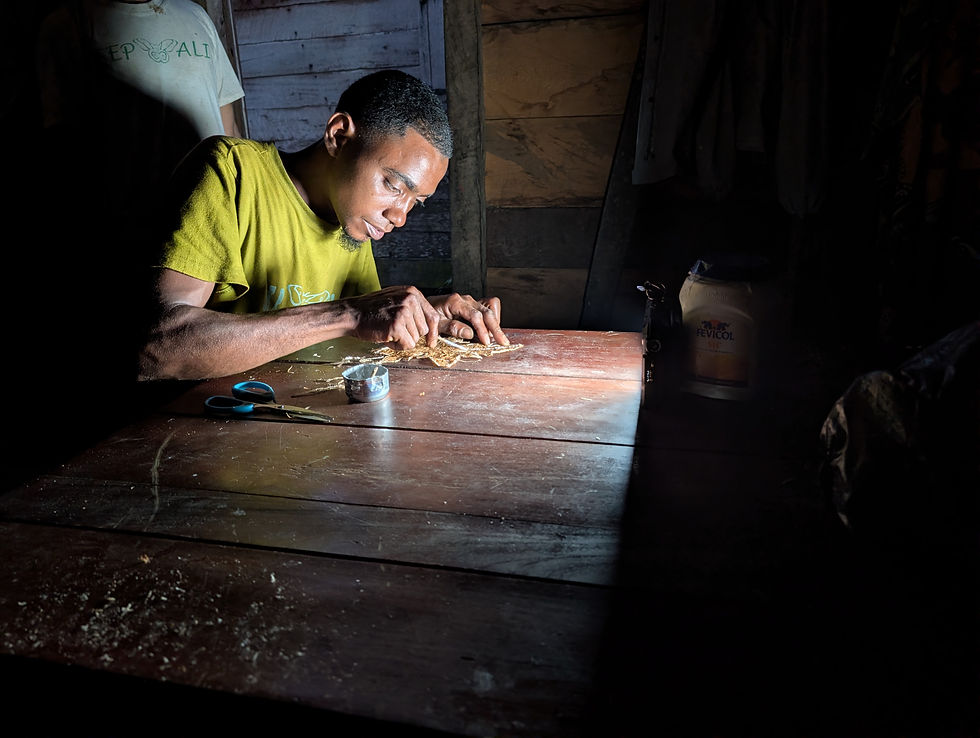
Above: A local farmer joins a wild silk artisan training in his Makira Natural Park-bordering village, continuing well after the sun had set and others had returned home. His piece, made from Ceranchia apollina endemic silk cocoons dyed with local lichens, will be included in a forthcoming exhibit of textiles from the Tanana Madagascar social enterprise. (Photo: Rachel Kramer/CPALI)

Above: Village-based artisan trainees near Makira Natural Park prepare a tapestry of endemic Malagasy birds crafted from silk cocoons on a foundation of loom-woven raffia palm. The trainees receive instruction from SEPALI Madagascar artisan mentors and are compensated for days devoted to skill development. When they're ready, they'll contribute to the Tanana Madagascar handcrafted product line. (Photo: Rachel Kramer/CPALI)

Above: Lead Artisan Lalaina Raharindimby works with SEPALI Madagascar artisans Hassina and Sabine to put finishing touches on the first original tapestry depicting endemic birds of Madagascar in wild silk. The tapestry was designed together with CPALI for exhibition at the upcoming Geography 2050: Africa Shaping Tomorrow conference in New York City in November 2026. (Photo: Rachel Kramer/CPALI)
Impact Area 4: Social Enterprise
In the past six months, CPALI has continued to cultivate markets that give back. Since January 2026, nine new outlets began carrying Tanana Madagascar handcrafted textiles. Special collections have been in development for launch in 2026 with Proud Mary, Ibu Atelier, and Selvedge. Bestsellers are also in current production for the Thistle Farms fall and winter collections. Every purchase from our social enterprise generates revenue that flows back into locally run programs. Maryland-based volunteers prepare and fulfill orders to keep operating costs sustainable. Through social enterprise and collaboration across oceans, every sale becomes an investment in people and nature, together.


Above: Proud Mary and Tanana Madagascar launched an original collection of five commissioned wild silk and raffia tapestries this season. The collection exhibits July-September at the Allegory Art Collective in Charleston, NC and will be the foundation of a new line of licensed prints -- rightfully elevating Tanana Madagascar artisans as artists. (Photo: Rachel Kramer/CPALI)

Above: An exciting new series of reed and pandanus handbags crafted by SEPALI Madagascar's village-based artisan trainees and veteran weavers has been under development by Tanana Madagascar this season for launch in the Ibu Atelier program Summer/Fall 2026. (Photo: Rachel Kramer/CPALI)

Above: CPALI lead volunteer Scherri Allen and World of Work Fellow Dahlia Ramirez inspect loom-woven Borocera cajani wild silk scarves before fulfilling them to a DC-based art museum. (Photo: Rachel Kramer/CPALI)
Impact Area 5: Arts & Culture
Traditional knowledge and artistic excellence deserve global recognition. Over the last six months, CPALI and SEPALI Madagascar have showcased locally made regenerative textiles in four exhibitions, introducing new audiences to innovative and traditional Malagasy natural materials and the stories behind every textile. Each exhibition has helped to elevate artisans as artists and innovators, preserving cultural traditions while creating new economic opportunities.

Above: CPALI Executive Director Rachel Kramer and Board Chair Petra Silton lecture on nature-positive textiles and exhibit Tanana Madagascar wild silk and raffia at a special dialogue on Prose and Materials: Translation and Emerging Arts from Madagascar at Vanderbilt University. The two-day event launched the new book, Return, by Malagasy author Jean-Luc Raharimanana, translated into English by Allison M. Charette. Professor, historian and anthropologist Dr. Tasha Rijke-Epstein moderated panel discussion. (Photo: Courtesy of Dr. Tasha Rijke-Epstein)
Impact Area 6: Uplifting Future Leaders
Every artisan trained, every farmer engaged, every student whose education continues because income was earned by parents represents an investment in Madagascar's future. During the past six months, 78 village-based artisans learned new skills to create nature-positive textiles. In June 2026, three young farmers were nominated by their community to expand their knowledge of regenerative livelihoods and become wild silk apprentices. Collaborating families gained greater confidence that conservation can provide lasting opportunity and bring beauty into the world.

Above: Mentors from the SEPALI Madagascar team journey down the Antainambalana River after delivering trainings for village-based artisans in remote rainforest-bordering communities. (Photo: Rachel Kramer/CPALI)

Above: SEPALI Madagascar Director Mamy Ratsimbazafy, artisan mentors from the SEPALI Madagascar team, and trainees in the rainforest-bordering village of Ambalamahogo smile after completing a day of training. Trainees are learning the art of tablet-weaving raffia fibers for Tanana Madagascar textiles and making coiled raffia and wild silk baskets for local sale. The initiative is seeded with a generous grant from Thistle Farms in Nashville, Tennessee. (Photo: Michael Listgarten)

Above: The first three sericulture (wild silk farming) apprentices nominated by their Makira Natural Park-bordering village prepared to learn moth ecology and sustainable rearing methods for wild silk production from SEPALI Madagascar Director Mamy Ratsimbazafy and the wider team. (Photo: Lalaina Raharindimby/SEPALI Madagascar)

Above: The new moth habitat constructed this spring at the SEPALI Madagascar demonstration garden. School children will visit each year to learn about endemic silk moths and wild silk textile production, inspiring a new generation. (Photo: Rachel Kramer/CPALI)
Looking Ahead
The numbers tell an inspiring story, but they're only the beginning. Behind each indicator is a family earning a fair livelihood. An artisan preserving generations of knowledge. A young person remaining in school. A community demonstrating that conservation and economic opportunity can grow together. This progress is possible because of supporters who believe that lasting conservation begins with local leadership. As we look toward the next six months, your support can help expand artisan training, grow forest regeneration, scale sustainable livelihoods, and sustain Madagascar's extraordinary biodiversity alongside the communities who know it best.
Together, we're proving that when people thrive, nature thrives too.
If our work inspires you, please consider making a donation or choosing a Tanana Madagascar handcrafted textile. Every contribution helps communities regenerate Madagascar's precious nature while building brighter futures—one family, one farm, and one opportunity at a time.
Please reach out to info@cpali.org with questions. Our team would love to hear from you.


