
Reflecting on two decades with CPALI

Updated: Dec 23, 2025
Leslie Brunetta, long-time CPALI Board Director and Clerk (2004-2025) and co-author of Spider Silk: Evolution and 400 Million Years of Spinning, Waiting, Snagging and Mating (Yale University Press 2010) with CPALI Founder Dr. Catherine Craig, reflects on two decades of service to the organization, and what she's learned watching CPALI grow from idea to impact.

Twenty-plus years ago, I joined CPALI as a favor to my friend and CPALI's founder, Cay Craig—she needed someone to take notes at board meetings.
If you regularly read CPALI Executive Director Rachel Kramer’s messages and reports—and before them, Cay’s—you’re familiar with the people working on CPALI and SEPALI Madagascar and their ongoing projects, including the amazing recent water hyacinth-biochar and clean drinking water initiatives.
This fall, I made way for new energy on CPALI’s Board of Directors. I’d like to highlight something that I think makes CPALI special and that is a big factor in the program’s success thus far. Back when I joined CPALI, almost everyone else on the board was a scientist. These scientists weren’t on the board just because that’s who Cay knew from her previous work. It was because the whole organization is based in science.
For better or worse (in this case, I think for better), scientists approach things differently from many other people. They may start with a hunch about how things work, but they tend to be skeptics, even about their own hunches. So before the actual organization launched, Cay built a team of Malagasy and foreign entomologists and plant biologists to test the foundations of her idea that using wild silkworms to help subsistence farmers raise income could lead to rainforest regeneration.

They spent many months going out into the proposed project area observing, counting, and collecting native silkworms, moths, and cocoons. They documented everything about them—where and when they mated, where and when they laid their eggs, what happened to the eggs (lots get eaten or parasitized, it turns out), how long it took for the eggs to hatch, what the silkworms did and ate after they hatched, what happened to them as they grew (lots get eaten or parasitized), when and where they started the metamorphosis process, and whether unharmed moths could hatch from the chrysalides if the farmers brought the cocoons inside away from predators and parasites and then cut away the surrounding silk so it could be flattened and sewn. There was a lot to take into account, and it happened on the silkworms’ schedule.
In one of the biggest boons to CPALI, Cay found and hired Mamy Ratsimbazafy, an entomologist who already had hands-on silkworm-raising experience. Mamy’s ability to get on well with and listen to farmers led to more scientific insights and nuanced knowledge about how to wrangle the silkworms and moths.

Not too long after Mamy was hired, he conducted what were essentially time-and-motion studies. He and Cay wanted to give farmers an accurate idea of how much time and effort silkworm raising and tree planting would actually take and what they might expect in return.
Meanwhile, the team built a tree nursery and silkworm-raising demonstration site—a lab, really—in Maroantsetra to test the process, gather more data, and refine techniques.

And then many of the farmers revealed themselves to have a scientific bent. Of course, most farmers around the world have this bent—without it, they’d have no way to adapt to constantly changing conditions. But the CPALI farmers were now part of a scientific community—they weren’t just following directions, they were trading knowledge and insights with Mamy and Cay, who took them seriously and adjusted procedures accordingly. Denis, one of the farmers, even started his own lab nursery.

This small international scientific community has grown and strengthened. No one just flies off self-confidently chasing hunches that seem self-evident—everything is tested and discussed. If the testing shows that something doesn’t work, it’s either abandoned or tweaked and retested until it does. CPALI and the Malagasy farmers and artisans all operate too close to the edge of survival to waste time and effort just because someone likes the idea of something.

Only those of us who have been involved from CPALI’s early days know how many times it seemed like the whole effort might fall apart. There have been devastating cyclones and resulting floods. Team members suffered life-threatening illnesses. There was a coup in 2009 that led to many international organizations leaving Madagascar. The pandemic lasted for years and still isn’t really over. Shipping product out of Madagascar is complicated. Adequate funding has always been an issue.
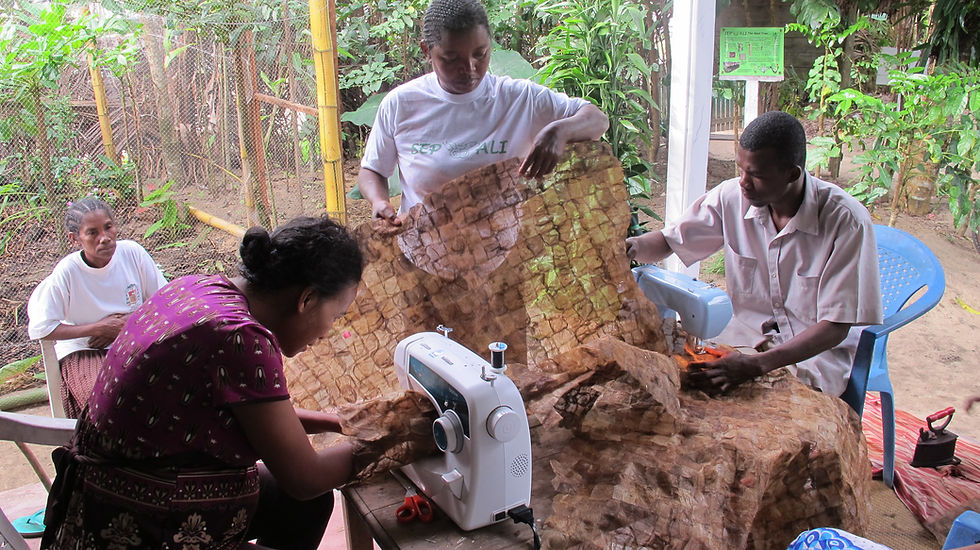
But the initiative never did fall apart, and I can confidently say that CPALI is stronger than ever. There are many reasons for this strength, first and foremost the team members in Madagascar and the United States. Also, Cay’s and Mamy’s leadership and the modesty—common to many but not all scientists—that has allowed them over the decades to see the work, not themselves, as most important. Then, too, of course, all the many faithful and patient CPALI donors.

But I would also argue that CPALI’s very slow start—because science (and silkworms) can’t be rushed—is the basis of most of its success, as frustrating and as touch-and-go as it sometimes was. Cay knew this approach was necessary if the program were to have any chance.

A truly scientific way of looking at things precludes a lot of poppycock and exaggeration. Farmers, artisans, wholesale and retail customers, and donors are attracted to CPALI's model in large part because it’s built and operated on an evidence-based foundation, not wild promises. Nothing in the future is certain, but all the testing and retesting done in the past makes the project’s future, at least, more predictable. This has allowed us all to have trust in each other.

I'm no longer on the Board, but I know I’ll always be involved with CPALI. I’m grateful to Cay for dragging me in all those years ago, and I’m grateful to all the wonderful colleagues, past and present, I’ve come to know, respect, and enjoy.
Without the generous support of people like you, none of our work would be possible. We're grateful for every gift made to our highest-ranking 501(c)3 non-profit. Visit: CPALI.org/donate

